

August 10, 2023 by The Psychedelic Pulse
TL;DR
- Researchers recently completed a study which evaluated the effects of 500 mg mescaline, 100 µg LSD, and 20 mg psilocybin
- They “…found no detectable difference in altered states of consciousness induced by 20 mg psilocybin, 100 µg LSD, or 500 mg mescaline”, and no severe side effects were noted for any substance
- Mescaline was found to have the longest duration of action, and the longest onset (time before effects began); LSD peaked faster and lasted longer than psilocybin
-
Today, we’re reviewing results of a recent study which compared effects across three psychedelics:
- Mescaline
- LSD
- Psilocybin
Specifically, researchers wanted to compare reported effects of these substances versus clinically measured effects in people.
The “War on Drugs” halted research into the effects of psychedelics. Which means proper scientific research is far behind anecdotal reports – “anecdotal” meaning personal reports, small individual narratives that have some use, but must be taken with many grains of salt.
Why?
Think of the personal stories you heard from older family members. You really gonna believe every word of every story Uncle Bill told? Of course not. The whole family knows Bill is full of shit. But he’s the only one who tried mushrooms so like, we just gotta take his word for it ya know?
Up until the past decade or two, that’s essentially what we worked with in terms of understanding the effects of psychedelics. Thankfully, we’re moving away from the Dark Ages (with respect to drug laws, at least). Scientists across the globe are studying psychedelics, helping make up for lost time.
In this article, we’ll review one such study with recently published results that, to be frank, are really freaking cool to see in a legitimate scientific journal. What a time to be alive!
Reported Effects of Mescaline, LSD, & Psilocybin
Mescaline, LSD, and psilocybin are all “serotonergic” psychedelics, which means they work by affecting serotonin. Serotonin is a chemical made naturally by your body. It’s a neurotransmitter, which means it delivers messages from your brain to nerve cells throughout the rest of your body.
Specifically, all three drugs act on serotonin 5-hydroxytryptamine-2A (5-HT2A) receptors. A receptor is a protein on the surface of a cell that can receive and interpret chemical messages – such as those sent by serotonin! The “2A” designation is used, because there’s more than one type of serotonin receptor (5-HT) in the body.
But dig further, and there are differences:
-
Mescaline binds to 5-HT2A, but also binds 5-HT1A, and adrenergic α2A receptors in a similar manner. “Adrenergic” means the signals involve epinephrine (adrenaline) or norepinephrine (noradrenaline).
-
LSD most potently stimulates 5-HT2A receptors, but also hits 5-HT2B/2C, 5-HT1A, and dopamine D1-3 receptors.
- Psilocin (the active metabolite of psilocybin) stimulates 5-HT2A receptors. At the same time, it also inhibits the serotonin transporter (SERT). Normally, SERT functions to reabsorb serotonin after it serves some function, stopping the action of serotonin. Blocking SERT keeps more serotonin in “active” circulation. (Many antidepressants work, at least partially, by blocking SERT.)
Here are the “reported” effects of these psychedelics. Remember, these are based on anecdotal reports. The researchers conducted the study to test these assumptions:

The Study: Comparing Subjective Reports to Clinically-Measured Effects
“To date, it is unknown whether the partly distinct pharmacological profiles of the classic psychedelics mescaline, LSD and psilocybin actually translate into distinct subjective effects in humans.
The main objective of the study was to detect potential pharmacological, physiological, and subjective/phenomenological differences between these three substances when used at doses that are equivalent in terms of the overall intensity of psychoactive effect, in order to facilitate interpretations across existing clinical trials and guide future designs and dose-finding for both research and therapeutic use.”
This study used a randomized, double-blind, placebo-controlled, cross-over design.
-
“Randomized” means study participants were randomly assigned to a treatment group. They weren’t given a choice of which substance they’d like to receive. Randomizing treatment assignment helps reduce the risk for bias to impact the study. It helps to ensure results are objective.
-
“Double-blind” means participants and researchers do not know who receives which treatment. This helps to stop researchers from treating certain participants differently based on the results researchers want to see. For example: if a researcher knows who received psilocybin and who received LSD, this knowledge can impact how they treat participants, which can affect the study results.
-
“Placebo-controlled” means some participants received a placebo – a fake drug with no active ingredient. Like, a pill full of sugar. (Imagine how disappointing it is to sign up for a study on psychedelics, only to end up in the placebo group.)
- “Cross-over” means study participants receive the same treatments, but in different orders. For example – this consisted of five separate 25-hour test sessions. One person may receive psilocybin in their first session and DMT the second session, while another receives DMT in their first session and psilocybin in the second session.
The doses of each substance were as follows:
-
Mescaline: 300 mg or 500 mg (milligrams)
-
LSD: 100 µg (micrograms)
-
Psilocybin: 20 mg
- Placebo: womp womp, dose doesn’t matter!
There were 34 total participants, age range 25 – 44 years.
Exclusion criteria (reasons which prevented people from participating in the study) included:
- Pregnancy/breastfeeding
-
Lifetime psychedelic use exceeding 10 sessions
-
Drug use (other than cannabis) within the preceding 2 months
-
Smoke 10 or more cigarettes per day
- Personal or family history of a major psychiatric disorder
The study consisted of five separate 25-hour test sessions. A participant was in a hospital room with one or two study investigators.
During the study, the following were measured:
-
Subjective effects (these are effects reported by the person participating in the study, such as “I feel high” or “I feel relaxed” or “I have no idea what’s going on right now”) of the drug assessed 1 hour before, and 0, 0.25, 0.5, 0.75, 1, 1.5, 2, 3, 3.5, 4, 5, 6, 7, 8, 9, 10, 11, 12, 14, 16, and 24 hours after administering the dose
-
Blood pressure, heart rate, and body temperature were measured at 0, 0.25, 0.5, 0.75, 1, 1.5, 2, 3, 3.5, 4, 5, 6, 7, 8, 9, 10, 11, 12, 14, 16, and 24 hours post-dose.
-
Side effects were assessed at 1 hour before, and 12 hours and 24 hours after the dose was given.
-
Oxytocin measured 1.5, 3, and 6 h post-dose; brain-derived neurotrophic factor (BDNF) levels were measured at 3, 6, and 12 hours post-dose
So, what did we find out?
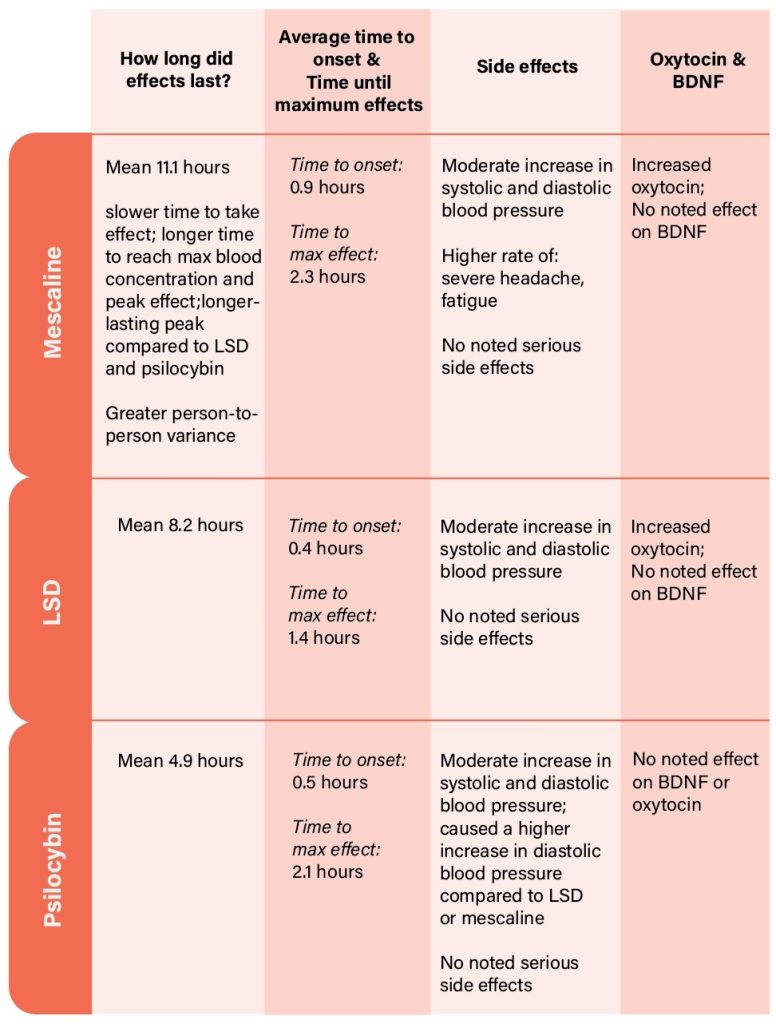
Neat, but how did people feel? How did trips compare?
I’m glad you asked, because this part fascinates me:
“Overall, the participants did not unequivocally distinguish mescaline, LSD, and psilocybin during the experience nor after the study.
…We found no evidence of qualitative differences in altered states of consciousness that were induced by 500 mg mescaline, 100 µg LSD, and 20 mg psilocybin.”
Across substances, people scored similarly on ratings of:
-
experience of unity
-
having a “spiritual” or “mystical” experience
-
feeling “transcendent” of time or space
-
blissful state
-
insightfulness
-
disembodiment
-
seeing complex or elementary imagery
- audio/visual synesthesia (“hearing” colors or “feeling” sounds)
This is further broken down by substance:
-
500 mg mescaline:
-
53.3% of people correctly identified they were given mescaline during the session
-
81.2% of people correctly identified they were given mescaline after the session
-
Most commonly mistaken for LSD (33.3%), 3 hours into the session
-
-
300 mg mescaline:
-
50% of people correctly identified they were given mescaline during the session
-
68.7% of people correctly identified they were given mescaline after the session
-
Most commonly mistaken for LSD or placebo (both 19.7%), 3 hours into the session
-
-
LSD
-
58.1% of people correctly identified they were given LSD during the session
-
68.7% of people correctly identified they were given LSD after the session
-
Most commonly mistaken for psilocybin or mescaline (both 16.1%), 3 hours into the session
-
-
Psilocybin
-
48.4% of people correctly identified they were given psilocybin during the session
-
78.1% of people correctly identified they were given psilocybin after the session
-
Most commonly mistaken for LSD (25.8%), 3 hours into the session
-
-
Placebo (no active drug)
-
96.7% of people correctly identified they were given placebo during the session
-
96.8% of people correctly identified they were given placebo after the session
-
A single participant mistook placebo for mescaline at the conclusion of one session
-
Implications
Had to get that out.
Circling back to our intro – we talked about how we have to rely on anecdotal reports (like from your “crazy Uncle Bill”) on effects of psychedelics, due to a lack of proper scientific research. Studies such as this one show that time is ending. We’re gaining significant insight into psychedelic effects in properly-controlled clinical trial settings.
For starters, let’s revisit some assumptions we discussed earlier that the researchers wanted to test. Remember, these assumptions are based on anecdotal reports from people taking psychedelics in recreational settings. But now, we’re also armed with results from this study.
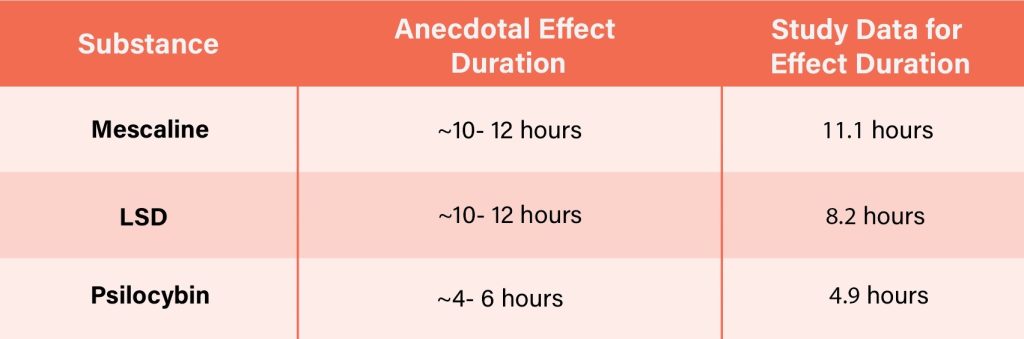
Not bad, “crazy Uncle Bill”!
Now, let’s look at some other interesting results:
Safety
All three substances produced some increase in systolic (the top number) and diastolic (the bottom number) blood pressure, but psilocybin had a notably stronger effect at raising diastolic blood pressure. This could have important implications for safe use in people with a heart condition, BUT – in this study, there were no cases of blood pressure increases that caused symptoms or lasting effects. Blood pressure readings returned to normal following the sessions. As stated in the “Discussion” section of the study:
“Altogether, autonomic effects of mescaline, LSD, and psilocybin were moderate, transient, and not a safety concern.”
Effects on Consciousness
From the study:
“We found no evidence of qualitative differences in altered states of consciousness that were induced by 500 mg mescaline, 100 µg LSD, and 20 mg psilocybin.”
Across substances, people scored similarly on numerous ratings, including: having an “experience of unity”, a “spiritual or mystical” experience, or feeling “transcendent” of time or space. Given that all three drugs work on 5-HT2A receptors, this tracks!
At this point, you may be wondering, “If people scored similarly across subjective ratings, does this mean mescaline, LSD, and psilocybin have similar or the same effects?”
Not exactly.
An important thing to look for when evaluating a study – do the authors discuss limitations to their study? Every sound scientific study should feature a review of limitations on the study. An example of a limitation on a study is, “Our study only included healthy participants” (one limitation from this study, in fact). Limitations place, well, limits on the conclusions we can draw from a study.
An important limitation on subjective experiences is noted near the end: “Lastly, our psychometric instruments may not have been sufficiently sensitive to capture the complex phenomenology of these substances.” In other words – the scales used may not be capable of capturing all the differences in experience from taking each substance.
Conclusions
I know this was a long read – big thumbs up to you for making it this far!
This study found no detectable difference in altered states of consciousness induced by 20 mg psilocybin, 100 µg LSD, or 500 mg mescaline. Researchers did find differences in how long effects lasted, with mescaline being the longest and psilocybin the shortest. Limitations to this study include the possibility that scales for detecting subjective experience and alterations in consciousness were not sufficient for capturing all differences, and a small sample size (32 participants).