

August 17, 2023 by The Psychedelic Pulse
TL;DR
-
A recent study compared the cost-effectiveness of psilocybin against other treatments for severe depression
-
Psilocybin plus therapy was found to be cost-effective compared to other treatments – depending on certain factors
-
Future research can build on this work to help better understand who might best benefit from psilocybin as a medical treatment
Healthcare is a business. And I don’t mean that in a cold, “companies have a right to charge whatever they want and if you don’t like it don’t pay for it” way. I mean that organizations – businesses, if you will – that operate by providing healthcare services still have bills to pay. Which means they have to juggle payroll and cash flow on top of trying to stop people from dying or whatever.
And, just like other businesses, healthcare organizations face an unfortunate reality: like other resources, healthcare resources are finite…
We have a finite supply of healthcare providers.
We have a finite supply of medications.
We have a finite amount of bandages and dressings and operating tables and operating room nurses and surgery technicians.
Even in healthcare, we have to make choices about how to distribute and utilize the finite resources available.
Enter: health economics, a branch of economics that works with how to deliver effective healthcare in an efficient manner. The goal – I’m generalizing heavily here, just work with me – is to find efficiencies and not waste our valuable, finite resources.
Today, we’re reviewing a recent study from a research group that includes faculty from Imperial College London and scientists with Clerkenwell Health (a commercial clinical research organization focusing on psychedelics). Published by Cambridge University Press, the study is titled, “Cost-effectiveness of psilocybin-assisted therapy for severe depression: exploratory findings from a decision analytic model.”
What is a Cost-Effectiveness Study?
A cost-effectiveness analysis compares the – wait for it – cost and effectiveness of two or more alternatives. In healthcare, these alternatives are different possible treatments.
Measuring cost is pretty straightforward. It’s not always as simple as it sounds, but this step is typically easy to quantify. Assigning a value to the outcome – the effectiveness of a treatment – is where things may get tricky. Luckily, smart mathematicians exist who can explain this better than I can. If you want to learn more about the nuts and bolts of the calculations, reach out to someone in the healthcare economics and outcomes research (HEOR) space – I promise they’ll be thrilled to speak with someone about their work (because they rarely if ever get the chance to do so outside). But we’re not getting into the weeds in this article.
However, we do need to quickly review a key measurement used in today’s study of interest, as it enables us to have a quality discussion about the results.
One measure evaluated in some cost-effectiveness studies is quality-adjusted life years (QALYs). QALYs measure how well a medical treatment improves the quality of life and lengthens how long a person lives, combining these two metrics into one number. QALY is considered an academic standard for measuring the cost-effectiveness of a treatment, and has been used by countries around the world to evaluate policy impact for over 30 years.
Study Results
In this study, researchers compared the cost-effectiveness of psilocybin combined with therapy for treating severe depression against the following treatments:
-
Conventional medication (antidepressant drugs)
-
Cognitive behavioral therapy (CBT)
- The combination of conventional medication and CBT
First – the “expected health costs” for each treatment came out as follows:
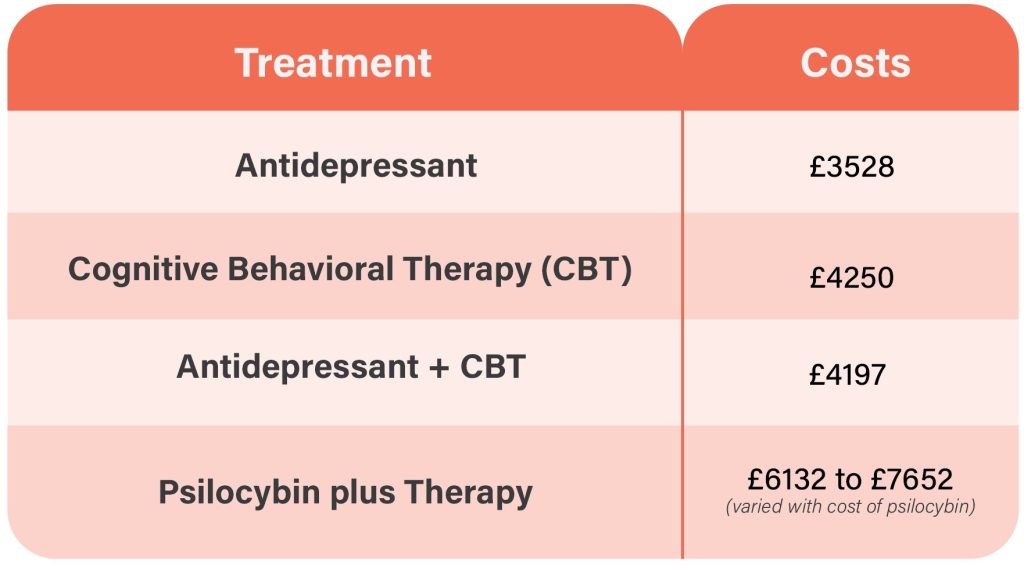
OK, not looking good for psilocybin from that perspective. But, we must remember to consider the effectiveness of treatment as well, not just the cost.
The next table details the effect each treatment had on quality-adjusted life years (QALYs):
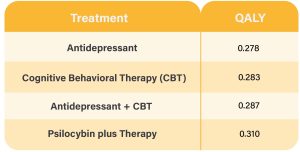
(For reference on the QALY scale – a score of 0.00 means “dead”, implying the treatment led to, well, death. A score of 1.00 means “perfect health”, indicating one year in perfect health.)
Implications and Limitations
Solely from a cost perspective, psilocybin plus therapy stands out as the most expensive option. However, the high cost of psilocybin is impacted by its classification as a Schedule I illegal substance. This isn’t me going off on my soapbox again, the researchers state as much in the paper:
“Firstly, psychedelics (including psilocybin) are controlled substances under Schedule 1 of the MDAct1971 and approval for their use in research studies must be specifically obtained. This adds considerable costs at present that will reduce once/if they become approved medicines.”
However, even at the lowest estimated psilocybin cost (£400 per person) used in the analysis, the cost of psilocybin plus therapy comes out to £6132 – still substantially more expensive than other treatments evaluated in the study.
So – the high cost of psilocybin plus therapy isn’t exclusively driven by the cost of psilocybin itself.
The researchers did find that adjusting the level of therapy support had a significant impact on the cost of psilocybin plus therapy. First, here is the level of therapy offered to participants who received psilocybin plus therapy as their treatment:
“In this example, participants with chronic medium to severe depression were allocated a pair of therapists (psychologists, psychiatrists, psychotherapists, or psychedelic researchers) to guide them through the therapeutic process.
This consisted of one course of treatment:
-
(i) a three-hour preparatory session with both guides,
-
(ii) a one-hour preparatory session with one guide before the second session,
-
(iii) two dosing sessions with 25 mg psilocybin, lasting four to six hours (assumed to be five for the purpose of this evaluation) and accompanied by both guides,
-
(iv) debriefing sessions after each dosing session with both guides present (assumed to be for two hours), and
- (v) up to three calls after each dosing session with the lead therapist (assumed to last 30 min).
It is recognised that this level of support is high and in sensitivity analyses we examine alternative scenarios.”
When the level of therapy support is dropped from a pair of therapists to one therapist, the researcher’s analyses showed psilocybin plus therapy to be the most cost-effective treatment for severe depression. This is important – think back to our discussion at the beginning of this article about limited healthcare resources. In many psychedelic clinical trials to date, particularly psilocybin, two therapists (or more) have been allocated to each patient per session. This is in part due to the legal classification of psychedelics – researchers must design the trials with extra precautions and go through additional safety regulations. While this approach has shown good results for patients, it isn’t cost-effective and difficult to scale – we simply don’t have enough therapists, they’re not allocated evenly across geography, etc. This study shows that one therapist can be assigned per patient per session, without affecting how well the treatment works for the patient. Further studies expanding on this work will continue working out practical ways to offer psilocybin plus therapy treatment at a local level.
OK, now a few limitations on this study we should keep in mind.
-
There weren’t many trials from which to collect and use data; so this study used data from clinical trials that aren’t as large or long as preferred;
-
The follow-up periods in these trials were short (ex: six weeks);
-
Cost estimates for treatments did not use real-time or recent inputs, but instead used the costs in the studies (which may now be dated)
-
We still need more data from much larger studies than what was available at the time this research was conducted
Conclusion
This study shows the potential cost-effectiveness for using psilocybin combined with psychotherapy for treating severe depression. The cost-effectiveness varies depending on a few factors, including the cost of psilocybin and the amount of care provided by therapists (including how many therapists are providing care to one patient). It’s estimated that these costs could decrease with changes to legal regulation regarding psilocybin.