
October 31, 2024 by Adam Miezio
TL;DR
-
Psychedelics and witchcraft go back as far as ancient Greece, with the legacy being passed down through Christianity perhaps, and eventually onto witchcraft in the Middle Ages.
-
“Witches’ ointment” or “flying ointment” fueled naughty behavior not approved by the Church and developed into a current XXX myth about how it was applied.
-
People tripping on a natural prototype of LSD probably caused the Salem Witchcraft Trials.
Historical Origins of Witchcraft
Witches and witch lore run deep in our collective psyche. The Witch’s Hat mushroom, the Wicked Witch of the West in the Wizard of Oz, Samantha in Bewitched, Hermione in Harry Potter, and the Halliwell sisters in Charmed all point towards our collective fascination with witches. However, our witch obsession reaches further back into history.
Even preceding the three witches in Macbeth, the figures of Medea and Circe in Greek mythology helped brand witches into our psyche. Ancient Greece was no stranger to psychedelics. The Greeks revered the Mysteries of Eleusis, which involved the psychedelic drink the kykeon. From there, the Mysteries of Eleusis may have been distilled into the psychedelic origins of Christianity, an idea discussed by Brian Muraresku, in his book The Immortality Key.
The Immortality Key “argues that psychedelics were the shortcut to enlightenment that founded Western civilization. It went from Eleusinian Mysteries to Dionysian Mysteries to the original Christianity. This was then passed on to the witches of the Middle Ages and Renaissance.” The psychedelic legacy passed down evolved into “witches’ ointment.”
In the interview below, psychedelia and witchcraft scholar Thomas Hatsis discusses witchcraft and psychedelic drugs. Hastis authored a book titled The Witches’ Ointment: The Secret History of Psychedelic Magic. The book explores “the untold history of the witches’ ointment and medieval hallucinogen use” and:
…reveals how the Church transformed folk drug practices, specifically entheogenic ones, into satanic experiences. In the Medieval period preparations with hallucinogenic herbs were part of the practice of veneficium, or poison magic. This collection of magical arts used poisons, herbs, and rituals to bewitch, heal, prophesy, infect and murder. In the form of psyche-magical ointments, poison magic could trigger powerful hallucinations and surrealistic dreams that enabled direct experiences of the Divine.
It’s interesting to note that the “witches’ ointment” stimulated “direct experiences of the Divine.” Today, these divine experiences are correlated with healing trauma, eliminating end-of-life anxiety and remedying substance abuse disorder and are not associated with heresy or satanism. One man’s trash is another man’s treasure. Furthermore, “witches’ ointment” posed a serious threat to the Church. The ability to access divine experiences, or commune with God on an individual basis, with no middleman or priest, and no mass, undermined the absolute authority of the Church. So what exactly was “witches’ ointment?”
“Witches’ Ointment” or “Flying Ointment”
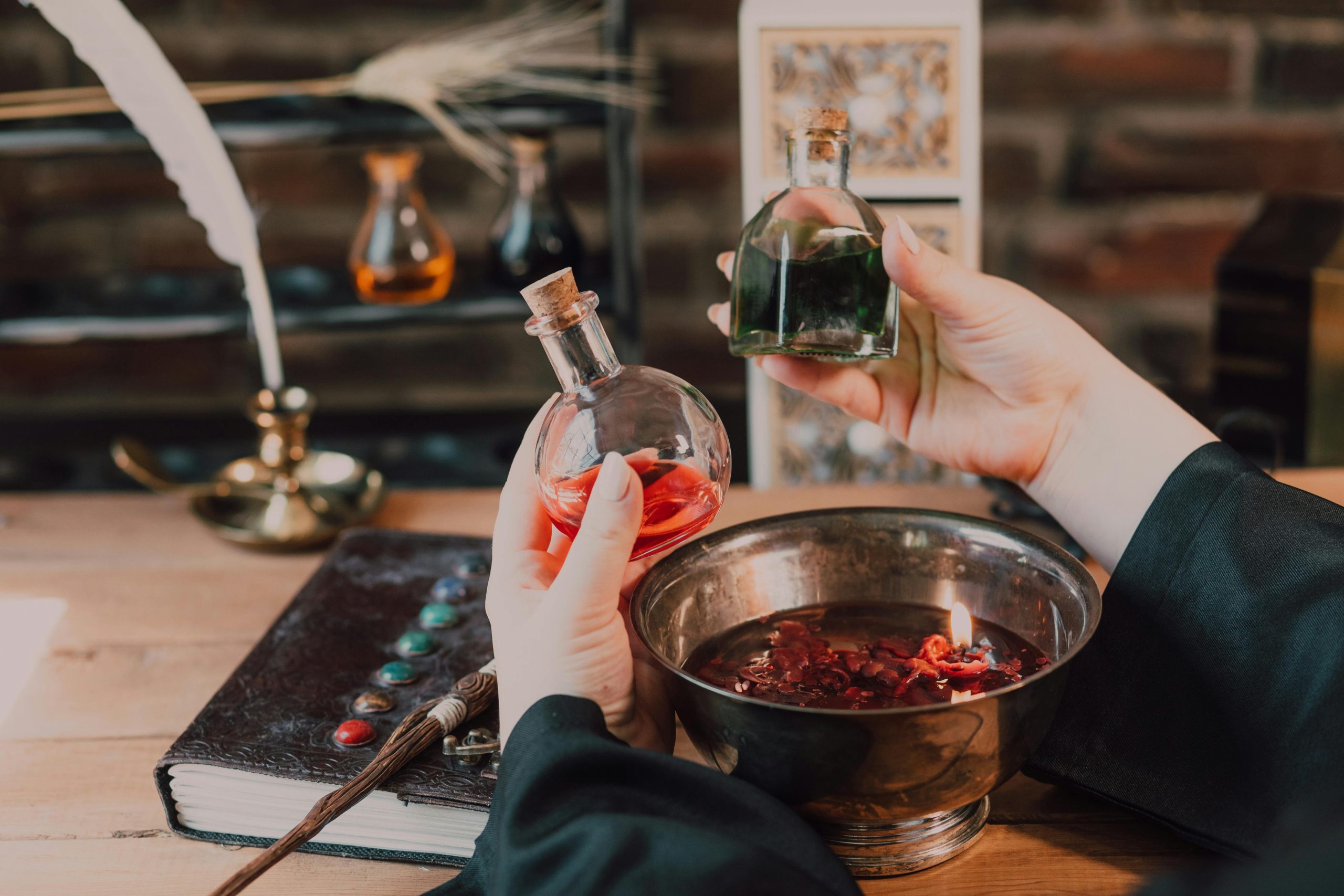
By the time the 13th century arrived, witchcraft and psychedelics enjoyed deep roots across Europe. Thanks to what might have been generational, psychedelic wisdom passed down over the ages, the witches of the middle ages employed what came to be known as “witches’ ointment” or “flying ointment.”
Of course due to much of the hysteria at the time, people believed this ointment allowed witches to fly, especially on their way to sabbat, or their devil worshiping ceremonies. However, the ingredients of this ointment have been debated for centuries.
Most historians and researchers believe that “the psychoactive tropane alkaloids contained in henbane (Hyoscyamus niger), thorn apple (Datura stramonium), belladonna (Atropa belladonna)” were the principal ingredients of witchcraft in medieval Europe.
Andreas de Laguna, a physician to Pope Julius III, commented on a tube taken from a witch and said that “the ointmentwas green in color and contained hemlock, salanum, mandragora, and henbane.” Nightshade may have also been used. During Shakespeare’s time, the “herbs most freely associated with witchcraft include nightshade, hemlock, henbane and mandrake.”
However a theory exists that “such herbs were associated with witches more because of their deadly poison than the fact that they were regularly employed as hallucinogens.” This idea lends credence to the political persecution of witches more as murderers by way of poison, than as heretics by way of psychedelics.
Regardless, witches also burned henbane, and inhaled the smoke. This provoked “a hallucinogenic state of mind where they cast spells and performed incantations to summon demons and other dark spirits to participate in their revelry.”
How witches ingested their psychedelic compounds and the “revelry” that followed comprises the most risque part of the witchcraft conversation.
Witches + Flying Ointment = NSFW
By the start of The Inquisition in 1184 witchcraft was becoming synonymous with devil worship. Things only got worse with the Spanish Inquisition following in 1478. Let’s face it, life in these times wasn’t exactly fun, especially for women. Hyper religious societies fomented hyper patriarchal societies. Throw in a touch of plague and famine, with the day to day misery of medieval peasant life, and getting out of a straw bed in the morning probably wasn’t easy.
People were probably looking for a bit of fun or “revelry.”
A lot of the hysteria swirling around witches and witchcraft had to do with female sexuality. The idea that women could express sexuality outside of a husband’s reproductive desires was unheard of, seen as an abomination, and thus got labeled as witchcraft. The paranoia reached a fever “witch” due to fears of inverting patriarchal power. There was still too much stigma swirling around female sexuality and none of the religious powers or churches were having any of it. Thus any interest in expressing female sexuality outside of reproductive endeavors was seen as deviancy and witchcraft.
“The Malleus Maleficarum, written in 1487 by German churchman and inquisitor Heinrich Kramer, is one of the European witch craze’s most infamous books and occupies a vital place within the history of sexuality.” In the essay, Woman/Witch: The Inherent Sexual Deviancy of Women’s Bodies in Malleus Maleficarum, Emma Williamson does a great job explaining the sexual hysteria of the time and the despicable influence of Heinrich Kramer.
Women may have been seeking “revelry” or something a little less, “missionary.” Heinrich Kramer must have rolled in his grave during the bra burning of the 1960s, as he likely thought just burning a bonnet was the epitome of “perverted sexuality” and witchcraft. Nonetheless, the hysteria reached its apex with psychedelics and broomsticks. Enter “flying ointment.”
XXX Psychedelic Broomstick Lore
Over recent decades a story has developed about the administration of “flying ointment” as explained by this Forbes article. The article states:
Somewhere along the line, the observation was made that the hallucinogenic compounds, hyoscine in particular — also known as scopolamine (found in belladonna and nightshade) — could be absorbed through sweat glands in the armpit or via the mucus membranes of the rectum or vaginal area. As compared to eating the plants or drinking their extracts, axial, rectal and vaginal routes of administration also bypassed the first cycle of rapid metabolism by the liver (and severe intestinal discomfort).
(For my front-row students who always kept me on my toes, some pharmacology texts state that rectal drug administration does expose as much as half of the absorbed drug to first pass metabolism as the superior hemorrhagic vein drains into the mesenteric circulation. So, the vulvovaginal and axial means of application detailed below are the ones that truly overcome first-pass hepatic metabolism.)
What better applicator for a witch than a broomstick? The idea that a psychedelic salve or ointment was applied to a broomstick for vaginal administration isn’t a ludicrous one. History shows that “ritual enemas and other psychoactive substances were also used to induce states of trance” by the Maya. “Flying ointments” were fat soluble, thus they could be spread over any part of the body or skin to be absorbed. Although a vaginal route of administration may be more effective, it wasn’t required or even true.
In this video by ESOTERICA, Dr. Justin Sledge says there is no historical evidence of “flying ointments” being applied to broomsticks. He states that this myth developed in the 1970s and that it is more likely that these ointments were “slathered all over the body.”
Some historians do think “flying ointments” were employed for recreational use, which begs some interesting questions. It is interesting to note the burgeoning number of sexuality themed seminars and workshops in the psychedelic space happening today. Are they a “spanish fly in the ointment?” The biggest and craziest, historical fly in the ointment for the Church and Christianity was yet to come.
The Suspected Psychedelic Culprit of the Salem Witchcraft Trials
By the close of the 17th century, the witchcraft hysteria had hundreds of years to ramp up into a full-fledged hysteria. But now with the discovery of the New World, the hysteria spread like an epidemic across the Atlantic. Enter Salem, Massachusetts. Witchcraft racked up a lot of frequent flyer miles riding broomsticks across Europe, and found a new host to bring to the brink of insanity. Speaking of a new host, when the Salem Witchcraft Trials began in February of 1692, it was like an infection, but not the type you’re thinking of.
The evil culprit of the Salem Witchcraft Trials may have been some moldy rye bread. Yeah that’s right- moldy rye bread. There was a possible outbreak of rye ergot prior to the Salem Witchcraft Trials. “Ergot is a fungus blight that forms hallucinogenic drugs in bread” and “the victims of ergot might suffer paranoia and hallucinations, twitches and spasms, cardiovascular trouble, and stillborn children.” Keep in mind LSD is “derived from the ergot alkaloids (as ergotamine and ergonovine, principal constituents of ergot, the grain deformity and toxic infectant of flour caused by the fungus Claviceps purpurea).”
If this theory is true, the unfortunate victims of the Salem Witchcraft Trials needed safe spaces and trip sitters, more than ducking stools. After some time, ducking stools were done away with, and suspected witches were simply tied to chairs, and thrown into water. If they floated, they were a witch, and if they drowned, they were innocent. In the case of the Salem Witchcraft Trials, 19 of the men and women found guilty of witchcraft were hanged. That’s one bad trip no one is coming back from.
Have We Learned Not to Fly Off the Psychedelic (Broomstick) Handle?
Let’s hope that we’ve learned enough about psychedelics by now and never repeat the horrific mistakes of “witchcraft” persecution of the past. One thing is certain though. Psychedelic journeys often produce visions of flight.
Many of the medieval practitioners of psychedelic plants medicines “would likely have experienced extremely vivid hallucinations involving flying off to destinations where many emotional states and physical activities were experienced. Period eyewitness accounts state that the force and intensities of these hallucinations, especially the vivid imagery, left the witches with memories that to them were as real as any other memory.”
During one of my first ayahuasca ceremonies, I experienced an intense vision of flying over the desert southwest of the United States. For people who have not used DMT or other psychedelics of similar potency, it’s hard for them to imagine just how real these visions are. They seem to be as real, if not more real, than our waking baseline reality.
As of this writing, I have yet to receive any witchcraft accusations or be strapped into a chair and tossed into water. Whether or not you enjoy any psychedelic-inspired visions of flight this Halloween, always remember the witches. These women, and sometimes men, flew in the face of the status quo centuries ago and fought for sovereignty over your consciousness and sexuality. Without them Halloween wouldn’t be half as naughty.