

December 28, 2023 by Bianca Schnarr
TL;DR
-
The 1971 UN Convention on Psychotropic Substances established the global prohibition on psychedelics and as of today has been signed by 185 countries.
-
Countries around the world have adopted unique laws to accommodate the use of certain psychedelics
-
Places like Australia, Brazil, Mexico, and the US, have altered policies to accommodate therapeutic potential and religious use.
The 1971 UN Convention on Psychotropic Substances established the global prohibition on psychedelics. As of today, it has been signed by 185 countries. To put that into perspective, the UN currently recognizes 195 countries. This Agreement placed DMT, LSD, MDMA, Mescaline, and Psilocybin in each country’s most restrictive drug categorization.
Despite these restrictive measures, countries around the world have adopted unique legislatures to accommodate indigenous, spiritual, and potential therapeutic applications of these drugs. If one has an interest in personal exploration and use of these substances, it is important to consider where you are and the legality of specific substances.
To better understand the distinction between legalized, and decriminalized refer to our article As always, this article is for educational purposes and not legal advice. Always check updated local rules and regulations. With all of this in mind let’s examine the current laws surrounding the most commonly used psychedelics in the world.
North America
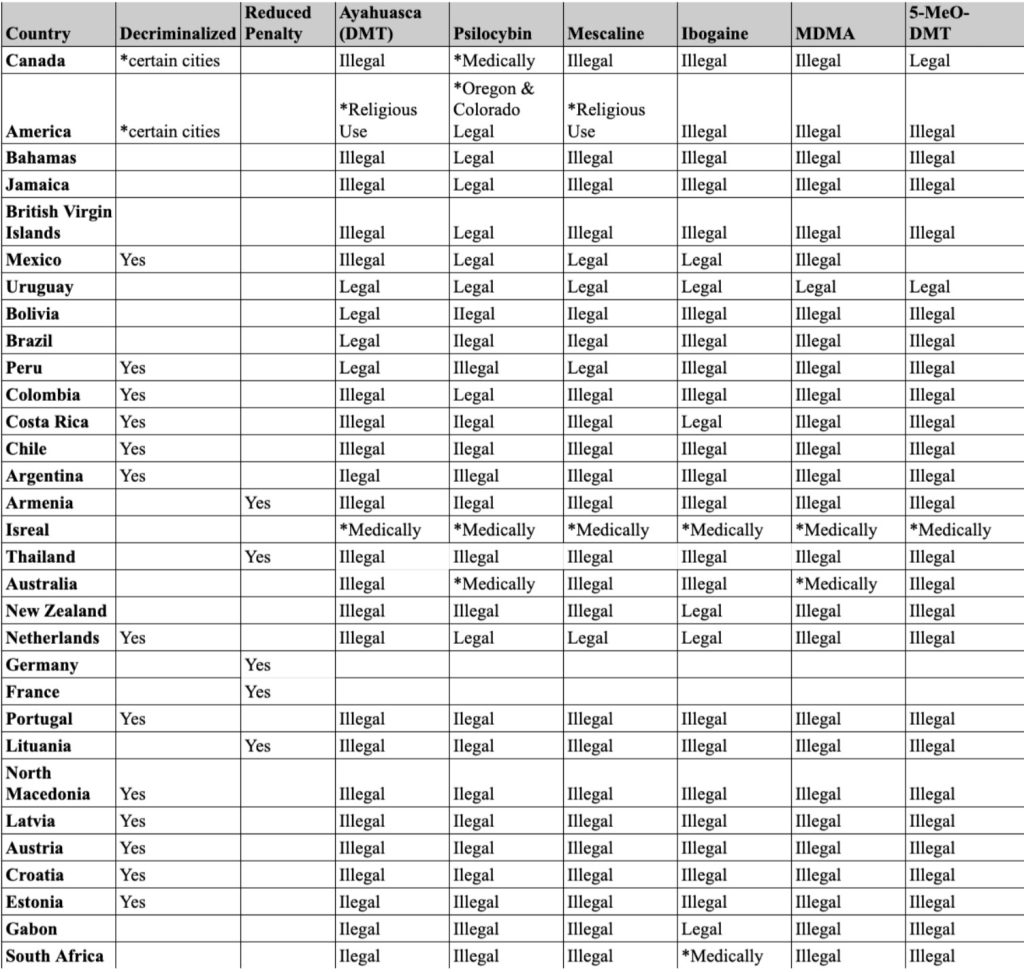
Psychedelic drugs are federally illegal in Canada, though have been decriminalized in certain cities like Toronto. However, in some instances, under doctor supervision, certain patients can access psilocybin legally. These pathways include clinical trials, special access programs, and individual subsection 56(1) exemptions. 5-MeO-DMT is not controlled in Canada.
America historically has been the forerunner in psychedelic prohibition. Currently, in the US, all known psychedelics except for ketamine are considered Schedule I substances, indicating a high potential for abuse and no therapeutic benefit. However, several cities and states throughout the country have taken steps to legalize and decriminalize the use of psychedelics.
Oregon and Colorado have both legalized the use of psilocybin mushrooms under proper supervision. Colorado has taken it a step further, decriminalizing the personal use of ibogaine, ayahuasca, and mescaline. The American Indian Religious Freedom Act of 1994 allows the use, possession, and cultivation of peyote by any individual involved in the Native American Church. The União do Vegetal (UDV) and Santo Daime are the two churches with religious exemptions to use Ayahuasca in America. America allows the use of Schedule I substances in clinical development and has been the leader in producing clinical evidence of psychedelics’ therapeutic potential.
Psilocybin-containing mushrooms are legal for possession, sale, and distribution in the Bahamas and Jamaica. They are also legal to possess and consume in the British Virgin Islands, though their sale is not.
South America & Central America
Due to the indigenous use of psychedelics in certain regions and early reform in other parts, this continent is home to some of the most progressive psychedelic policies in the world.
Uruguay legalized the possession of small quantities of all drugs for personal consumption in 1974. In Bolivia, Brazil, and Peru, Ayahuasca is legal. In Bolivia, the ingredients are readily available at markets. Countries like Chile, Ecuador, and Argentina have also decriminalized psychedelic drugs. In Mexico and Costa Rica, small quantities of psychedelics are not punishable by law. Mexico also permits the use of psilocybin mushrooms and peyote for spiritual ceremonies.
Asia
Most Asian countries enforce harsh criminal punishment for drug possession, though a select few have made recent efforts to lessen penalties. In 2017 Thailand decided to lessen their penalties for possession of psychedelics and other illegal substances. In 2022, they announced they would begin research into psilocybin as a therapeutic molecule.
In Armenia, small quantities (the quantity is ill-defined) only face up to a $400 fine.
Israel was the first country to allow compassionate use of MDMA to treat Post Traumatic Stress Disorder (PTSD). They allow the use of any “dangerous” drugs prescribed by a doctor.
Australia & New Zealand
As of July 2023, Australia approved MDMA and psilocybin for PTSD and treatment-resistant depression, respectively. Ibogaine is also utilized as a prescription medication.
New Zealand allows psychoactive substances to be manufactured, imported, or sold (not consumed) if pre-approved by the government. Ibogaine is a legal non-approved prescription, meaning it can be prescribed despite it not being federally approved for any particular indication.
Europe
In Ukraine, small quantities of psychedelic drugs are legal. In places like Switzerland, Portugal, and Spain, small amounts for personal use are decriminalized. In Switzerland, the União do Vegetal Church (UDV) can legally use ayahuasca under religious exemption.
Psilocybin spores, truffles, grow kits, and liquid peyote are legally sold in the Netherlands. Ibogaine is unregulated in the Netherlands. While countries like Germany and France carry reduced penalties.
Africa
Traditional use of Iboga is permitted in Gabon and Cameroon. South Africa allows medically supervised prescription/use of ibogaine. However, many other African Countries remain restrictive.
Conclusion
So despite the nearly global prohibition that began only 50 years ago, countries around the world are taking a stand for what they feel is right. Beginning with gradually lessening the severity of punishment for non-violent drug-related crimes. To recognize certain psychedelics as historical tools of religious sacrament that people have been utilizing for millennia. Finally progressing to the point we are at now, acknowledging that these drugs are not only safe but have great therapeutic potential.
Site to Visit:
Worldwide Psychedelic Laws