
January 25, 2024 by Bianca Schnarr
TL;DR
-
2023 pilot study investigates new forms of administration of “purified ayahuasca” intranasally, using dissolving tablets (buccal), and capsules.
-
The largest challenge with the traditional ayahuasca plant brew is batch-to-batch and person-to-person variation.
-
Of all the administration methods tested the combination of dissolving tablet (buccal) harmine and nasal delivery of DMT showed the most desirable absorption and metabolism, greatly reducing variability.
Researchers sought to recreate a purified version of Ayahuasca to optimize the experience in this study. They tested peroral (oral) administration of a capsule containing purified N,N-dimethyltryptamine (DMT), and harmine against combined oromucosal (buccal) harmine tablets and intranasal DMT spray in a clinical trial involving 10 healthy male subjects.
To understand the innovation of this approach one must understand what is and how ayahuasca has been used historically. We covered DMT previously, a super quick rundown of DMT can be found here.
Ayahuasca is a plant brew that consists of the boiled stems of the Banisteriopsis Caapi vine and leaves of the Psychotria Viridis shrub. The major alkaloids of these plants are harmine and DMT respectively. Harmine is a beta-carboline, which is a class of compounds that allows the DMT to become orally active, by stopping rapid breakdown (metabolism) by Monoamine Oxidase (MAO) in your gut. Previously researched routes of DMT administration bypassing metabolism in the gut include IV and inhalation to maintain psychoactivity. Though these methods reduce the psychedelic experience to 15-30 minutes on average.
This traditional medicine has gained interest due to the potential therapeutic effects of DMT. However, using a boiled plant drink in a clinical setting is quite difficult. The largest challenge with the traditional plant brew is batch-to-batch variation, which leads to problems with dosing and expected reaction/effect. Potential intolerability of plant materials in the brew, and differences in activity for metabolizing enzymes between individuals also create unpredictable dosing paradigms. All of these factors also contributed to the increased likelihood of adverse events like nausea, vomiting, and diarrhea with the brew. It should be noted these “purgative” effects are considered a part of the healing indigenously, despite the way they are characterized clinically.
Researchers approached this study with three main hypotheses:
-
Purifying DMT and harmine could facilitate precision in dosing.
-
Bypassing the GI tract could reduce differences in bioavailability between users and potentially increase effect predictability.
-
A more consistent plateaued absorption rate could increase psychological tolerability by mediating the onset of effects.
Study Design
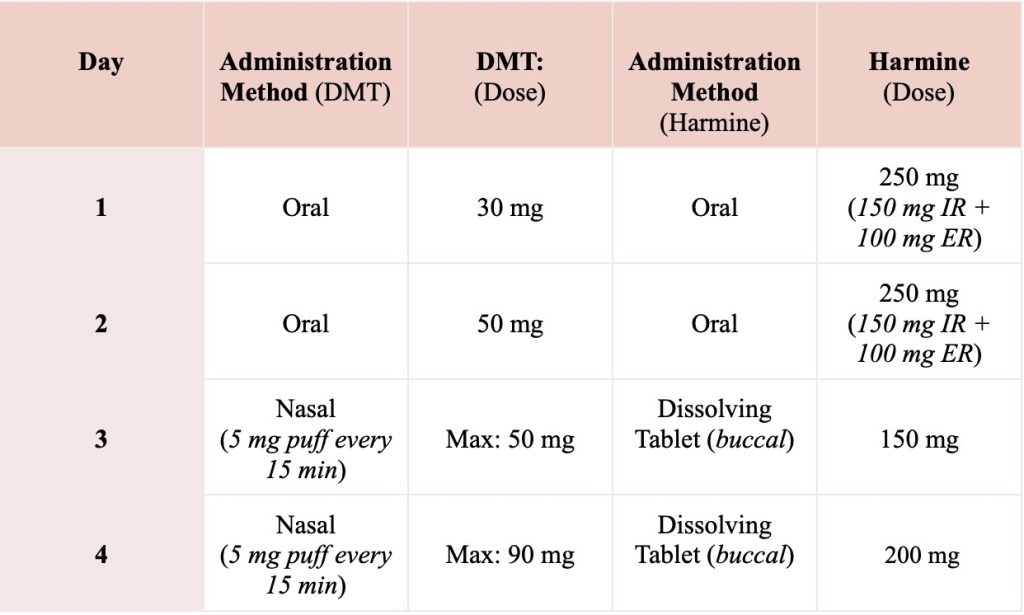
The experiment was a non-random open-label pilot study. Meaning it was the first of its kind, and that the researchers and patients were aware of the drug and dose being received. 10 male subjects participated during the 4 study days. The following figure outlines the dose regimens used.
Results
Researchers found that overall DMT/harmine effects gradually subsided 135 minutes after the first DMT administration with milder effects lasting up to 300 minutes. The intensity of effects experienced by participants correlated to the amount of harmine and DMT in the blood, and were enhanced during days 3 and 4. There were low to moderate elevations in heart rate and blood pressure correlating to peak drug intensity, a phenomenon observed across psychedelics.
Nausea, vomiting, and diarrhea were significantly reduced in researched formulations as opposed to traditional ayahuasca. Of all the administration methods tested, the combination of dissolving tablet (buccal) harmine and nasal delivery of DMT showed the most desirable absorption and metabolism, greatly reducing variability.
Conclusion
The novel methods of dosing produced in this study demonstrate improved patient tolerability. Compared to the traditional ayahuasca brew, both combination methods of administration provided more homogeneous plasma concentration profiles and improved predictability of subjective effects. The self-determined, repeated-intermittent administration of DMT via nasal spray demonstrated also enhanced controllability and safety, particularly valuable for potential applications in psychiatric patients.
There are limitations to the study like a small sample population lacking in diversity. Despite the drawbacks, this study tackled one of the most important challenges faced in the psychedelic world, clinical access. Understanding the potential benefit of psychedelics like DMT and harmine on a large scale requires an investigation of what method of administration would be best tolerated for optimal therapeutic effects.
These results also open an avenue for researching the effects of DMT and harmine, mechanistically and therapeutically. Harmine, as well as the other beta carbolines present in ayahuasca, produce psychoactive effects independent of DMT, which has the potential to exert its own therapeutic qualities as well as contribute to DMT effects. Additionally, Ayahuasca, based on the region and tribe brewing, often contains a manifold of additional/substituted plants. The pharmacological impact of these additional plants and the diverse array of compounds within those plants have been often overlooked in psychedelic research. Including both DMT and harmine in the dosing regime reinforces the necessity of understanding what impact additional metabolites have on the drug experience.
There is still so much to be answered about the mechanism, use, therapeutic potential, and culture of ayahuasca. This study is an insightful endeavor to discover more about this indigenous brew, within the confines of Western clinical application.
Studies Cited:
-
Dornbierer, Dario A., et al. “Overcoming the clinical challenges of traditional ayahuasca: a first-in-human trial exploring novel routes of administration of N, N-Dimethyltryptamine and harmine.” Frontiers in Pharmacology 14 (2023).
-
Passos, Ioannis D., and Maria Mironidou-Tzouveleki. “Hallucinogenic plants in the Mediterranean countries.” Neuropathology of drug addictions and substance misuse. Academic Press, 2016. 761-772.