

February 29, 2024 by Alex Brewer, PharmD, MBA
TL;DR
-
A groundbreaking study shows positive outcomes as psychedelics and SSRIs coexist in the fight against depression
-
Research reveals the potential of safely combining psychedelics with antidepressants for effective depression treatment
To date, studies for psilocybin and psychedelics in treating treatment-resistant depression (TRD) commonly require participants to stop using serotonergic antidepressants, such as selective serotonin reuptake inhibitors (SSRIs), due to a concern that the antidepressant could interfere with the psychedelic.
There is also a possibility for psychedelics and serotonergic antidepressants to interact. A drug interaction occurs when one medication or substance alters the expected effect on the body of another medication or substance.
Based on previous studies, reports from patient surveys indicate that using an antidepressant in the months or weeks leading up to ingesting psilocybin or LSD can dampen the acute psychedelic effects. And, it’s thought that the acute psychedelic experience plays some important role in the efficacy for psychedelics in treating depression. (The exact mechanism for this action is currently unknown. Us scientists are making our best guess at the moment!). In addition, psilocin (which your body forms after ingesting psilocybin) is known to inhibit the serotonin transporter, which can affect how well an SSRI drug works.
Withdrawing from an SSRI isn’t something that should happen overnight. The dose is typically slowly lowered over several weeks, especially for SSRIs such as fluoxetine which have a long half-life. There are instances where withdrawing from an SSRI isn’t feasible given the time necessary. The study we’re discussing today answers important unknowns regarding the safety of undergoing psychedelic treatment while still taking an SSRI.
Important Study Info
This study by Goodwin et al. was published in Nature in 2023. It involved 19 participants who received a one-time 25 mg dose of COMP360 (Compass Pathyway’s psilocybin candidate) plus psychological support. They were then followed for 3 weeks.
The primary endpoint (the #1 outcome the study wanted to evaluate) was the change in the Montgomery-Åsberg Depression Rating Scale (MADRS) total score from Baseline at Week 3. MADRS is a tool clinicians use to assign a “score” and measure severity of depressive episodes in people with a mood disorder. Why do we need to “score” people’s depression? With mood and psychological conditions, scoring symptoms and stratifying severity is how we measure where a patient is at and where we hope treatment will take them.
When treating high blood pressure, we can measure blood pressure and compare it to set targets for “healthy” and “not so healthy”. When treating diabetes, we can measure the amount of sugar in your blood and compare it to targets for “healthy” and “not so healthy”. With depression and mood disorders…there’s nothing objective we can “take” from your blood and measure it and compare it against objective, evidence-based targets for “healthy” vs. “not so healthy”.
So, to evaluate whether a treatment works for depression or another mood disorder, clinicians will continuously administer tests such as MADRS and compare the patient’s results over time. By comparing results over time, we can see what affect treatments, life events, and other variables play in affecting symptoms.
Study Results
Onto the results.
At week 3, there was a mean change in baseline MADRS total score of -14.9. An improvement of two or more points on MADRS is considered clinically relevant. 42.1% of participants experienced not only a response to treatment (such as a reduction in MADRS), but a remission in their depression.
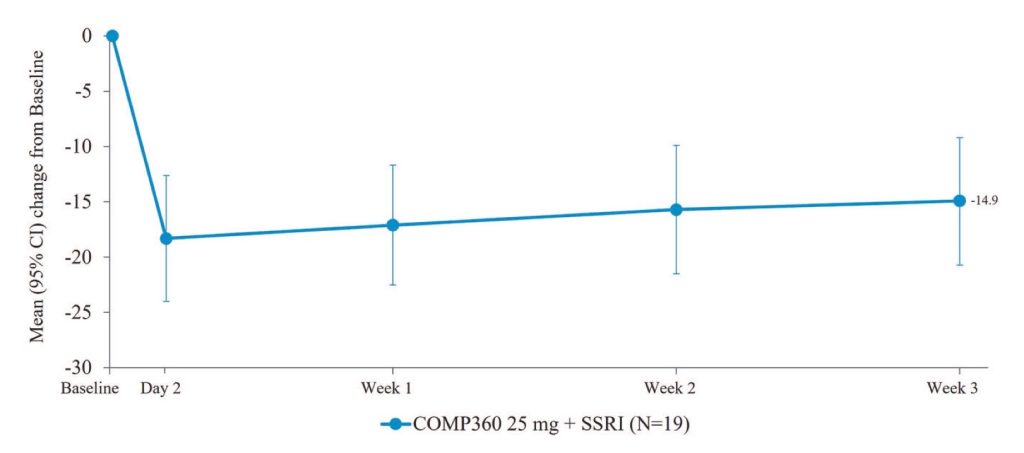
Image: Change from baseline in MADRS total score
Source: https://www.nature.com/articles/s41386-023-01648-7.pdf
63.2% of participants had a treatment-emergent adverse event (a fancy term for “side effect”). However, there were no reports of serious side effects or increases in suicidal ideation or behaviors. Most side effects were not only mild, but they went away the same day.
Conclusion & Looking Forward
Moving forward, this study opens the door for larger, Phase III studies evaluating the effectiveness of combining psychedelic-assisted therapy with an antidepressant medication.
This could be an important use for psychedelics, and may be pivotal in gaining approval from the FDA as legitimate treatments – the FDA prioritizes reviewing drugs which intend to treat conditions for which there aren’t many treatments. And, treatment options for treatment-resistant depression are currently limited. If future studies in large, diverse populations find that combining psychedelic-assisted therapy with an SSRI or other antidepressant is effective for depression, it will further strengthen the case for legalizing and regulating psychedelics as medications.