
November 28, 2024 by Adam Miezio
TL;DR
-
John Lilly invented the float tank, tested it on himself, and took LSD while floating.
-
Lilly’s fame reached new heights trying to teach dolphins English by giving them LSD.
-
Lilly was the inspiration for the cult hit movie Altered States.
The current psychedelic revival puts heavy focus on mental health, trauma, and healing from those maladies. At times, contemporary psychedelic culture feels like it’s boxing up nonconformities that don’t fit the healing narrative, and dropping it in the lost and found. Sorting through the misplaced history, a jack-in-the-box pops out. That person is John Lilly, a psychedelic, high priest of weirdness who pushed boundaries and the brain.
Life & Background of John C. Lilly
John C. Lilly was born on January 6, 1915, in St. Paul, Minnesota. Lilly died September 30, 2001, in Los Angeles, California at age 86. Numerous passions motivated Lilly to become a writer, inventor, psychonaut, philosopher, physician, psychoanalyst and neuroscientist. (John Lilly has no relation to the Eli Lilly pharmaceutical company. )
Lilly first studied biology at the California Institute of Technology, where he earned his bachelor of science degree. After reading Aldous Huxley’s Brave New World, Lilly gained inspiration to further pursue his interest in biology, with a specific focus on neuroanatomy and neurophysiology. In 1938, Lilly entered Dartmouth where he studied anatomy and worked on dozens of cadavers. Lilly’s anatomy and physiology passion peaked, and he ultimately enrolled in the University of Pennsylvania seeking better medical research opportunities.
At the University of Pennsylvania, Lilly debuted his first invention, a blood pressure measuring device. He was also introduced to computers at the university and co authored a book titled, How to Build an Atomic Bomb that stirred controversy. However when the late 1950s and 1960s arrived, Lilly spent a large amount of his academic focus studying psychedelics.
Due to Lilly’s psychedelic research and fringe ideas he attracted interest of the counterculture and its members. Lilly was friends with Ram Dass, Werner Erhard, Allen Ginsberg and Timothy Leary. Lilly rode the 1960s’ counterculture wave to the Esalen Institute in Big Sur, California. From 1969 to 1972, Lilly resided at the Esalen Institute as he found the ideal place to cultivate his fringe ideas among the “hip” West Coast scene he loved. He also befriended Jeff Bridges, William Burroughs, and Robin Williams.
Since Lilly was a polymath, his interests, studies, and projects manifested in a myriad of ways. Lilly left behind 19 books and a disparate legacy that still impacts both scientific and psychedelic fields today. Lilly’s work included LSD, isolation tanks, dolphins, and he even inspired movies.
Sounds like a clue on Jeopardy, right?
Floating in an Infinite Sea of Consciousness
When Lilly wasn’t mapping the pain pleasure pathways in the brain for the first time, he was a mad inventor of sorts. In 1954, while working at the Public Health Service Commissioned Officers Corps, Lilly invented the world’s first isolation tank. It would be later called a sensory deprivation tank, and today is known as a float tank.
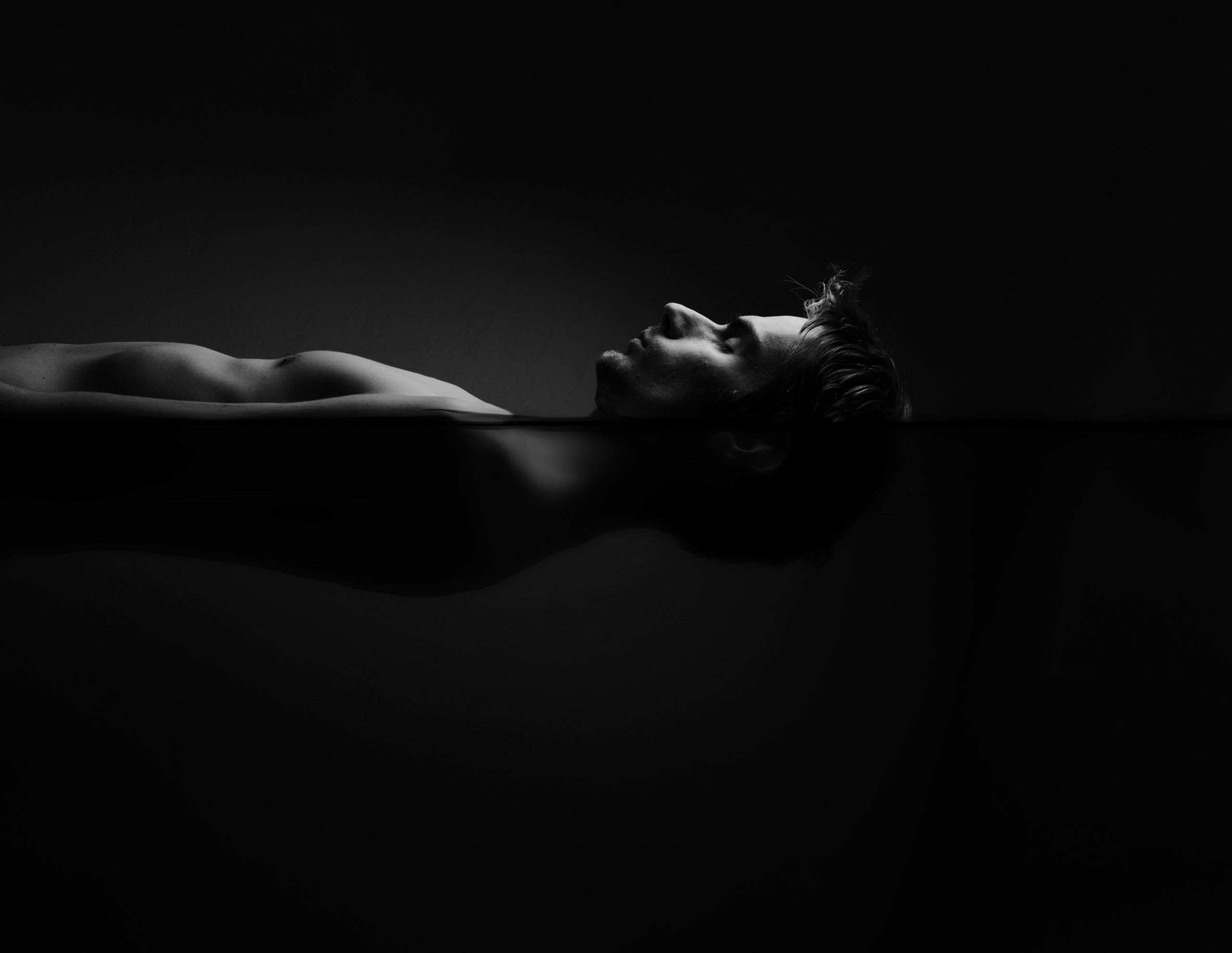
The original deprivation tank suspended a person in 160 gallons of water, and submerged the body, leaving only the top of the head exposed. The person was given a “black-out” mask, which supplied air and blocked all light from entering the eyes. The contraption look like something from a torture chamber.
Lilly designed the float tank “…for intensive study of human consciousness when deprived of as much external stimulus as possible.” Lilly and his colleague Dr. Jay Shurley at the National Institute of Mental Health thought that in this environment the brain would simply shut down.
However, something quite unexpected happened.
Lilly and Shurley used themselves as lab rats and entered the float tank for the first time. They suspended themselves for hours in warm salt water. Their discovery surprised them. “They were not slipping into a comatose state, nor was it the least bit distressing. Instead, Lilly found his time in the tank surprisingly profound and physically rejuvenating.”
Years later, psychedelics came across Lilly’s radar, and they fascinated him. He conducted various experiments with mind-altering drugs, including ketamine and lysergic acid diethylamide (LSD). So when you have a float tank sitting in front of you, and a handful of LSD, what do you think happens?
Yeah that’s right. You take some acid and get into the float tank!
Lilly redirected his research angle with float tanks. Instead of using them as an avenue to offer peace and relaxation from external pressures and distractions, Lilly’s obsession became fixated on “…mind travel and exploring alternate realities.” In Lilly’s book The Center of the Cyclone (1972), he described his first float tank LSD experience: “I traveled through my brain, watching the neurons and their activities.”
Then in 1972, Lilly met Glenn Perry. Perry recommended that Lilly add salt to the water to raise the specific gravity, to make it easier to float on the surface. The float tank went from a vertical operation, to a horizontal one, and the Samadhi float tank design was born. Lilly and Perry manufactured float tanks and in 1973 opened up a float tank center in Beverly Hills. Celebrities became big fans, including Susan Sarandon, Michael Crichton, and Robin Williams. Some people consider the float tank to be Lilly’s greatest legacy.
(Because this was a news story, CBS doesn’t tell you that floating is best done naked.)
Today, a contemporary float tank is an enclosed saline bath (holding 800 pounds of Epsom salt), in which the air and water temperature match the surface temperature of the skin. Thankfully, yesteryear’s torture mask is unnecessary There is no light inside, and no sound. People liken it to floating in space or being back in your mother’s womb.
The salt-saturated water’s density enables floating on the surface. Since the water and air temperature match skin temperature, the body becomes seamless with the environment and it’s no longer felt, except for the face and head. It is the first time since you left your mother’s womb that you have not experienced any incoming, external stimuli. You don’t have to move a single muscle, tendon, or ligament. You float on your back with zero effort. Pure darkness and pure silence envelop you.
What will you find in the silent darkness?
As the 13th century Persian poet Rumi said, you might find that “You are not a drop in the ocean, you are the entire ocean in a drop.” The float tank is like meditation on steroids and is a consciousness tool. Once a person becomes adept using it, psychedelic experiences are not uncommon. Float tanks are excellent for rest and relaxation, but also healing and recovery. Today many athletes use float tanks to ease physical wear and tear. Moreover, with all the Epsom salt, float tanks are super for the skin.
I have heard conversations about using float tanks as integration tools following psychedelic journeys. I have yet to see this offered at a retreat, or anywhere. Being a former floater myself, I couldn’t recommend this enough and I’d love to use it for integration. Although float tanks have become more mainstream in recent years, it’s a shame they’re not included and discussed more in today’s psychedelic revival.
John Lilly would be proud.
John Lilly’s Dolphin Research
Lilly’s fascination with cetaceans began in 1949, when he had an encounter with a beached pilot whale near his home in Massachusetts. The size of the animal’s brain amazed him and the animal’s potential intelligence seized Lilly’s imagination. Later in the 1950s Lilly and his wife found Marine Studios in Miami, the first home of a bottlenose dolphin in captivity.
While observing the dolphins, Lilly learned the dolphins’ ease learning tricks and how playful they are. Lilly presumed that a deeper intelligence underpinned their behavior. He began studying dolphins at Marine Studios, where he conducted brain mapping work. Not long after, the idea that dolphins could communicate and talk with humans gripped Lilly, and he poured his soul into studying the possibility.
During Lilly’s research, he discovered what he interpreted as an ambition of the dolphins to speak with humans. He detailed his theory in a 1961 book called Man and Dolphin. The possibility of interspecies communication thrilled the public, making the book a bestseller. The bestseller also attracted the interest of NASA.
On the heels of the book’s success, Lilly earned financial backing from NASA and other government agencies, which allowed Lilly to open his new Caribbean laboratory in 1963. He sought to cultivate more intimate relationships between man and dolphin. The lab was called the Communication Research Institute, and was known informally as, The Dolphin House. Lilly used a wide variety of techniques to attempt to teach dolphins English.
Lilly never did accomplish teaching dolphins English or proving they could speak. However, he did produce some notable stories. Lilly studied 3 dolphins, and utilized float tanks with them. Lilly even had an assistant named Margaret Howe Lovatt spend time with Peter in a float tank which culminated in an awkward moment.
“During the isolation period the dolphin, named Peter, began making sexual advances towards researcher Margaret Howe Lovatt, who chose to relieve the animal’s urges because it was proving to be disruptive to the training.”
Lilly’s dolphin research came at the height of the LSD explosion of the 1960s. Lilly administered LSD to the dolphins hoping that the psychedelic would induce communication. Although Lilly found the animals to be much more vocal, it still didn’t produce intelligible speech. Lilly himself took LSD and would attempt to speak with the dolphins and spent lots of time with them under the influence of psychedelics. Lovatt, who loved dolphins, objected to the continuing LSD experiments on the dolphins.
In 1966, funding for Lilly’s project would be cut off, Peter would be relocated, and sadly commit suicide in captivity. Despite the sad ending, Lilly’s work increased the awareness and respect of marine mammals in scientific circles.
Creative Inspiration Du Jour
Thanks to Lilly’s eccentricities and fascinating studies, both he and his research became the inspiration for a number of books, movies and TV shows. Lilly was mentioned as a pioneer in the 1972 book The Listeners and he was most famously the inspiration for Arthur C. Clarke’s 1963 novel Dolphin Island: A Story of the People of the Sea.
Lilly also served as the inspiration for the 1973 movie The Day of the Dolphin starring George C. Scott. The TV series Stranger Things, based character Dr. Martin Brenner on Lilly. However, one movie holds special status as a cult hit and will forever keep Lilly’s legacy alive.
That movie is Altered States.
The 1980 movie stars William Hurt who reverts to a primitive, simian form after ingesting a psychedelic and spending a prolonged period of time in a float tank. If you’re a fan of sci-fi or horror, and haven’t seen the movie, it’s worth a watch. However, do NOT watch the cult hit prior to floating for the first time. You may never be able to look at a float tank the same way again.
Lilly Couldn’t Get Weird Enough
When Lilly wasn’t on LSD in float tanks and hanging out with dolphins, he spent whatever available time he had to explore human consciousness. He spent time with Ram Dass, studied yoga in-depth, claimed to have achieved spiritual peak states, and trained with a spiritual leader in Chile.
Among his many fringe ideas, Lilly predicted a malevolent “solid state intelligence,” and he also believed in cosmic entities. He called a lower class of these entities the Earth Coincidence Control Office. Lilly also dabbled in the Search for Extraterrestrial Intelligence (SETI) project and tried to estimate intelligent civilizations in the galaxy. Lilly earned countercultural icon status and his achievements may never be surpassed.
Did anyone blend genius and weirdness as well as Lilly did? Read Lilly’s life maxim and decide for yourself.
In the province of the mind what one believes to be true, either is true or becomes true within certain limits. These limits are to be found experimentally and experientially. When so found these limits turn out to be further beliefs to be transcended. In the province of the mind there are no limits. However, in the province of the body there are definite limits not to be transcended.
– John C. Lilly